
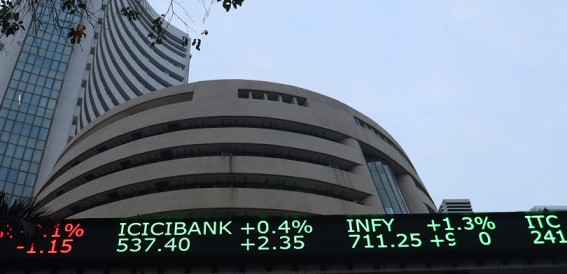
The Indian share market is navigating a complex but cautiously optimistic phase marked by high valuations, global uncertainties, evolving domestic sentiment, and sector-specific divergences. While benchmark indices continue to hover near record highs, the market is also experiencing bouts of volatility driven by global economic developments and profit-taking by investors. As we study the present environment, it becomes clear that the market is neither overheated nor collapsing; rather, it is consolidating within a defined range, waiting for definitive triggers that may determine its next direction.
In recent sessions, the benchmark indices—the Nifty 50 on the National Stock Exchange and the S&P BSE Sensex on the Bombay Stock Exchange—have exhibited a mixed but stable trend. On 21 November 2025, the Sensex closed at 85,231.92, slipping approximately 400 points or 0.47 percent. The Nifty 50 mirrored this movement, ending the day at 26,068.15, also down nearly 0.47 percent. Market analysts emphasize that the Nifty has formed a strong support zone around 25,800 while encountering resistance near 26,200. These levels have created a trading corridor that reflects the current equilibrium between bullish optimism and cautious restraint. The indices’ behaviour suggests that although the market is not under immediate threat of a major downturn, investors are consciously balancing risk as they respond to shifting macroeconomic dynamics.
A significant driver of market sentiment at the moment is the global economic backdrop—particularly interest-rate expectations in the United States. Stronger-than-anticipated U.S. employment data has dampened the prospects of an early rate cut by the Federal Reserve. With the world’s largest economy showing persistent resilience, global markets, including India’s, remain cautious. Elevated global valuations further contribute to this prudence, as investors worldwide weigh the risk-reward balance before increasing exposure. When the U.S. Fed signals a reluctance to ease monetary policy, equities across emerging markets tend to feel the ripple effect, and India is no exception.
On the domestic front, the Indian market’s proximity to record highs has prompted a phase of profit-booking. Certain sectors, most notably metals and real estate, have seen noticeable pullbacks. On 22 November, the Nifty Metal index declined by nearly 2.5 percent, while the Nifty Realty index dropped around 1.86 percent. Another sign of rising caution is the recent jump in the India VIX, the volatility index, which surged by about 12 to 13 percent in a single session. A rising VIX typically signals heightened nervousness and indicates that market participants are bracing for sharper fluctuations.
Another structural concern is the declining participation of foreign institutional investors (FIIs) and foreign portfolio investors (FPIs). Data suggests their holdings in Indian equities have recently touched multi-year lows. Although domestic institutional investors and retail participants have mitigated the impact by steadily supplying liquidity, reduced foreign inflows can limit the market’s upward momentum. Given that FIIs are often influential in determining short-term market direction, their waning interest creates an element of fragility. This does not imply an imminent downturn, but it does underline the need for stronger domestic triggers or renewed foreign enthusiasm to sustain a robust rally.
From a technical standpoint, the market remains in a consolidation phase. After a six-day winning streak earlier in the month, indices retreated as investors reassessed valuations. The Nifty’s support at 25,800 and resistance at 26,200 act as the key markers for traders and analysts. Should the index clear the resistance zone decisively, it could pave the way for a move towards 26,700. Conversely, a breach of support could drag the index back to around 25,350. This technical setup reinforces the perception that the market is currently searching for clarity while avoiding extreme movements.
Sectoral performance further highlights the unevenness in the current phase of the market. The information technology sector has shown resilience even amid broader weakness. Stocks like Infosys, for instance, saw gains of over 2 percent following announcements related to share buy-backs. This suggests selective interest in segments that stand to benefit from global outsourcing demand and stable earnings visibility.
In contrast, cyclical sectors—including metals, realty, and public-sector banks—have come under pressure. These industries are more sensitive to global demand, commodity trends, and domestic credit conditions. As a result, their recent decline aligns with the broader cautiousness prevailing across global markets. Analysts now recommend selective participation rather than broad-based sector exposure. In fact, some market experts have suggested opportunities in smaller, undervalued stocks—such as those priced below ₹100—particularly for investors willing to take higher risks for potential long-term gains.
Looking ahead, the near-term outlook for the Indian share market will largely depend on key triggers. In the coming weeks, traders will closely monitor support and resistance levels on the Nifty. A breakout above 26,200 could spark renewed bullish momentum, while a drop below 25,800 may indicate a short-term correction. Global economic indicators—including U.S. interest-rate policy, inflation data, and commodity prices—will continue to exert considerable influence. Movements in the rupee-dollar exchange rate, which affect import costs and corporate profitability, will also be critical.
Flow-related dynamics will remain significant as well. Foreign inflows, domestic mutual fund activity, and retail participation will collectively determine liquidity strength. As the earnings season has just concluded, markets may experience a temporary lull in corporate-driven momentum. In this gap, macroeconomic announcements, government policy changes, or geopolitical developments may take center stage as potential catalysts.
Over the medium to long term, several structural themes will shape the trajectory of the Indian market. Valuations remain elevated, and the sustainability of current market levels will depend on whether earnings growth keeps pace. If corporate performance fails to meet expectations, the market could slip into a corrective phase. However, India’s long-term economic narrative—powered by demographic expansion, rapid digitalization, and infrastructure growth—remains compelling. Investors with a multi-year horizon may find comfort in the structural strength of the economy, but must remain mindful of valuation risks.
Policy clarity will also be essential. Government actions related to taxation, investment regulations, and corporate governance can significantly influence investor confidence. Meanwhile, sector rotation—driven by global economic realignment, technological shifts, and changing consumption patterns—may redefine market leadership. Where technology once dominated global equity narratives, sectors like manufacturing, infrastructure, and energy transition may emerge as the new pillars.
Despite the prevailing optimism, several risks should not be overlooked. India’s equity markets remain sensitive to foreign flows, and any risk-off sentiment globally could disproportionately impact indices. Global macro shocks, such as sudden inflation spikes or geopolitical crises, could derail market stability. Domestic corporate earnings disappointments could weaken valuations, while technical breakdowns below support levels may accelerate selling pressure. Additionally, if domestic interest rates remain high or liquidity tightens, the attractiveness of equities relative to fixed-income instruments may diminish.
In conclusion, the Indian stock market stands at a delicate yet promising juncture. While the indices remain near historic highs, the environment is marked by heightened uncertainty and selective confidence. Investors today are navigating between the compelling long-term growth story of India and the short-term risks posed by valuations, global cues, and liquidity conditions. For now, a stock-specific approach appears wiser than broad-market positioning. Careful monitoring of global trends, domestic flows, and critical technical levels will be essential. In a market where uncertainty and opportunity coexist, disciplined strategies—supported by hedging, prudent allocation, and defined stop-losses—will ensure more resilient participation.