
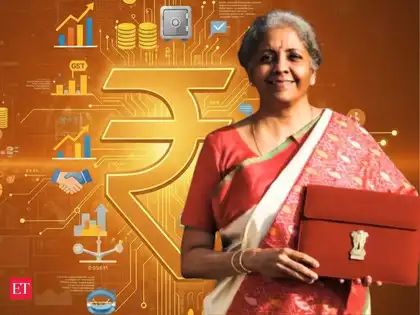
India’s Union Budget 2026-27, presented by Finance Minister Nirmala Sitharaman on February 1, 2026, emphasizes fiscal discipline, infrastructure growth, and manufacturing revival amid a projected 10% nominal GDP increase. Total expenditure is set at ₹53.47 lakh crore, up 7.7% from 2025-26 revised estimates, with key focuses on capex, tax reforms, and sectoral schemes.
Budget Overview
Total receipts excluding borrowings stand at ₹36.52 lakh crore, rising 7.2% year-over-year, driven by net tax revenue of ₹28.67 lakh crore (up 7.2%). Gross tax revenue targets ₹44.04 lakh crore, with corporation tax at ₹12.31 lakh crore (11% growth) and income tax at ₹14.66 lakh crore (11.7% growth). Capital receipts excluding borrowings hit ₹1.18 lakh crore, boosted by ₹80,000 crore in disinvestment—136% higher than prior revised figures.
Fiscal deficit is targeted at 4.3% of GDP (down from 4.4%), revenue deficit at 1.5%, and primary deficit at 0.7%, aligning with a debt-to-GDP goal of 50±1% by 2031. States’ tax devolution rises to ₹15.26 lakh crore (9.6% increase), plus ₹1.85 lakh crore in capex loans.
Expenditure Breakdown
Revenue expenditure grows 6.6% to ₹41.25 lakh crore, capital outlay 6.3% to ₹9.43 lakh crore (total capex ₹12.22 lakh crore, up 11.5%). Interest payments consume ₹14.04 lakh crore (26% of total spend, up 10.2%).
| Ministry | Allocation | % Change from 2025-26 RE |
|---|---|---|
| Defence | 7,84,678 | 7.1% |
| Road Transport & Highways | 3,09,875 | 7.9% |
| Railways | 2,81,377 | 10.1% |
| Home Affairs | 2,55,234 | 5.7% |
| Rural Development | 1,97,023 | 4.4% |
Subsidies total ₹4.55 lakh crore (down 3.1%), with food at ₹2.28 lakh crore and fertiliser at ₹1.71 lakh crore.
Key Schemes
Major allocations include VB-G RAM G (₹95,692 crore, replacing MGNREGA), Jal Jeevan Mission (₹67,670 crore, up 298%), and PM Awas Yojana Urban/Rural (₹22,025 crore/₹54,917 crore). New initiatives: SME Growth Fund (₹10,000 crore), Biopharma SHAKTI (₹10,000 crore over 5 years), and 5,000 crore per City Economic Region.
Tax Reforms
No changes to income tax slabs; new holidays until 2047 for foreign cloud providers via Indian data centres and extended IFSC units (15% post-20 years). STT hikes: futures to 0.05%, options to 0.15%; buybacks taxed as capital gains with promoter levy (22-30% effective). TCS cuts: education/medical to 2%, overseas tours to 2%; MAT reduced to 14%, no credits post-April 2026. Customs exemptions for 36 life-saving drugs, EV components, and manufacturing inputs.
Sectoral Highlights
Infrastructure: ₹12.2 lakh crore capex (4.4% GDP, highest ever); new freight corridor (Dankuni-Surat), 20 waterways, 7 high-speed rails.
Manufacturing: Revive 200 clusters, ISM 2.0, footwear/leather scheme (22 lakh jobs), container manufacturing.
Agriculture: Horti-Bharat VISTAAR, cashew/cocoa programs, coconut scheme, fisheries value chain.
Health/Education: 10,000 medical seats, 5 medical tourism hubs, 5 university townships, AVGC labs in 15,000 schools.
Energy: CCUS (₹20,000 crore/5 years), rare earth corridors, nuclear exemptions to 2035.
📊 1. Macro-Fiscal Framework (Numbers & Targets)
📌 Overall Budget Estimates
- Total Expenditure: ₹53.47 lakh crore, ~7.7 % higher than the revised estimate for FY 2025-26.
- Receipts (excluding borrowings): ~₹36.5 lakh crore.
- Gross Tax Revenue: ~₹44 lakh crore; taxes expected to grow ~8 %.
- Nominal GDP growth projected: 10 % for FY 2026-27.
- Debt-to-GDP ratio target: ~55.6 % in 2026-27; path to ~50±1 % by 2030.
📌 Fiscal & Revenue Deficits
- Fiscal deficit: Targeted at 4.3 % of GDP.
- Revenue deficit: ~1.5 % of GDP.
📌 Borrowings & Financing
- Net market borrowings: ~₹11.7 lakh crore.
- Gross market borrowings: ~₹17.2 lakh crore.
💰 2. Tax Reforms & Policy Overhaul
✔ Income Tax
- No change in existing personal income tax slabs for FY 2026-27.
- New Income Tax Act 2025 to come into effect April 2026 — modernisation & simplification.
✔ Direct Tax Compliance
- Measures to settle disputes by paying outstanding dues.
- Rationalisation of TDS/TCS provisions to ease business compliance.
✔ Customs & Trade
- Duty exemptions on fisheries (EEZ / high seas catch) to boost exports.
- Courier export threshold of ₹10 lakh per consignment removed to support MSME overseas sales.
🏗️ 3. Capital Expenditure & Infrastructure
📌 The Budget prioritises infrastructure to sustain growth:
- Capital Expenditure: ~₹12.2 lakh crore — record high.
- Railways: Expansion including corridors & modernization.
- 7 High-Speed Rail Corridors proposed.
- Logistics, ports, waterways and freight corridors also emphasised.
Long-Term State Support
- ₹1.85 lakh crore in 50-year interest-free capital loans to states.
🏢 4. Expenditure Priorities & Allocations
🔸 Social Sector
- Education: Major expansion of schools (~15,000) and colleges (~500) with focus on AI and digital education.
- Health: Increased allocations & new medical tourism push.
🏡 Rural & Urban Development
- PM Awas Yojana Urban & Rural — funding raised after past underspend.
- Jal Jeevan Mission support.
- Rural employment and Viksit Bharat Gram Yojana funded robustly.
🪖 Defence
- Estimated ~7–8 % overall rise including ~17.6 % capital allocation increase for modernization & indigenisation.
🌾 5. Agriculture & Allied Sectors
📌 Total agriculture allocation ~₹1.62 lakh crore (~7 % higher than last year).
Key Agriculture Announcements
✔ KCC (Kisan Credit Card) loan limit increased from ₹3 lakh to ₹5 lakh — boosts rural credit.
✔ Special development programmes for high-value crops: coconut, cashew, cocoa, sandalwood.
✔ Integrated development of 500 water bodies for inland fisheries.
✔ Duty-free provisions on EEZ / high seas fish catch — aimed at exporters & fishermen.
✔ AI-enabled Agri-tool “Bharat VISTAAR” for crop planning, market links, weather alerts.
✔ PM-Kisan Samman Nidhi to continue.
🏭 6. Industry, Manufacturing & Tech Push
📌 Government continues focus on economic competitiveness:
- Semiconductor Mission 2.0 — enhanced support for chip ecosystem.
- Biopharma, electronics & rare earths incentives bolstered to reduce import dependence.
- Chemical Parks: 3 new parks to attract investment.
- MSME support via corporate partnerships and credit initiatives.
🏙️ 7. New Schemes & Social Initiatives
Finance Minister announced multiple new development schemes targeting inclusive growth:
- Lakhpati Didi Yojana — economic empowerment of rural women
- Mahatma Gandhi Gram Swaraj Yojana — comprehensive rural development
- National Handloom & Craft Plan — traditional crafts support
- National Fibre Scheme — textile sector boost
- Cloth Expansion & Employment Scheme — jobs in textiles
- Corporate Partner Scheme — MSME-corporate linkages
- Coconut Promotion Scheme — for coconut farmers
- Bharat Vistar Plan — regional growth initiative
- Two schemes for Divyangjan — disability support
- Tourism Guide Pilot Plan — tourism enhancement
- Biopharma Shakti Yojana — strengthen biotech innovation
📈 8. Revenue Transfer & State Support
- Transfer to states: ~₹26.2 lakh crore (~12.2 % increase).
• Includes tax devolution (~₹15.3 lakh crore) and grants & capital loans (~₹10.9 lakh crore).
🧭 9. Policy Theme & Vision
“YUVA Shakti-Driven Budget”
The Budget narrative emphasises three “kartavyas” (duties):
- Accelerate & sustain economic growth
- Fulfil aspirations & build capacity
- Inclusive participation & “Sabka Sath, Sabka Vikas”
Focused on a Viksit Bharat vision, macro stability, integration with global markets, and long-term growth orientation.